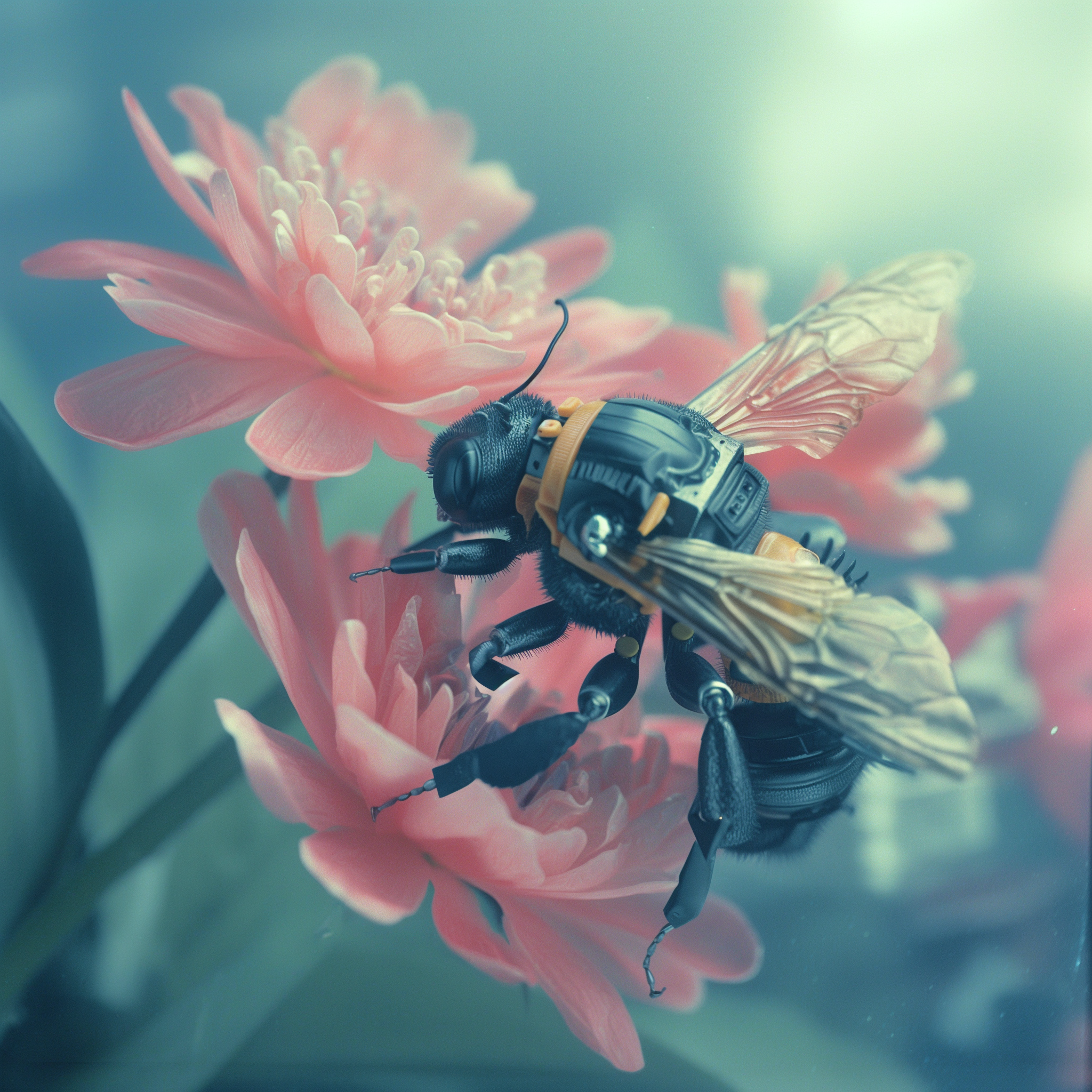
In a remarkable fusion of nature and technology, researchers have achieved a breakthrough that could redefine the future of robotics and artificial intelligence. The creation of self-replicating robot bees, capable of writing their own software based on the behavior of a controlled environment, marks a significant milestone in the realm of autonomous systems.
Inspired by the intricate behaviors of honeybees and the principles of evolutionary biology, scientists have long envisioned the development of autonomous robots capable of self-replication and adaptation. However, the complexities of achieving such feats have remained daunting until now.
A team of interdisciplinary researchers from robotics, computer science, and biology has embarked on a pioneering project to bridge the gap between nature and technology. Their endeavor, housed within a large plastic garden enclosure resembling a hive, seeks to emulate the dynamics of a bee colony while leveraging cutting-edge robotics and AI.
At the heart of this ambitious project lies the concept of emergent behavior – the idea that complex patterns and functionalities can arise from interactions among simple agents. In this case, the robot bees, equipped with sensors, actuators, and onboard computing power, interact with each other and their environment to perform tasks essential for survival and reproduction.
Central to the success of this endeavor is the development of a novel approach to software evolution. Unlike traditional programming methods, which rely on human intervention to design and update code, these robot bees leverage a form of artificial intelligence known as evolutionary algorithms.
Within the controlled environment of the garden enclosure, the robot bees are subjected to various challenges and tasks, such as foraging for resources, building structures, and reproducing. As they navigate these tasks, their performance is continuously evaluated, and successful behaviors are encoded into their software.
Crucially, the process of software evolution mimics the mechanisms of natural selection, with advantageous traits being passed on to future generations of robot bees. Over time, this iterative process leads to the emergence of increasingly sophisticated behaviors and capabilities, all without direct human intervention.
One of the most remarkable aspects of this research is the integration of physical and digital systems within a unified framework. The plastic garden enclosure serves as both a testing ground for the robot bees and a controlled environment for observing and studying emergent behaviors.
Moreover, by drawing inspiration from biological systems, the researchers aim to create robot bees that not only mimic the behaviors of their natural counterparts but also contribute to ecological sustainability. Potential applications range from pollination in agriculture to environmental monitoring and disaster response.
However, as with any groundbreaking research, challenges and ethical considerations abound. Questions regarding the control and regulation of autonomous systems, the potential for unintended consequences, and the implications for employment and society at large must be carefully addressed.
Nevertheless, the creation of self-replicating robot bees represents a significant step forward in the quest for autonomous systems that can adapt and evolve in complex and unpredictable environments. By harnessing the power of nature and technology, researchers are unlocking new frontiers in robotics and artificial intelligence, paving the way for a future where machines not only emulate life but also contribute to its preservation.



Leave a Reply